Lecture 8: Marks and Channels
2026-02-17
Marks and Channels
This lecture is based on Chapter 5 of Visualization Analysis & Design.
“Marks and Channels”
Marks and Channels
The goal of this chapter is to understand the basic geometric elements that depict items or links (marks) and control their appearance (channels).
Marks
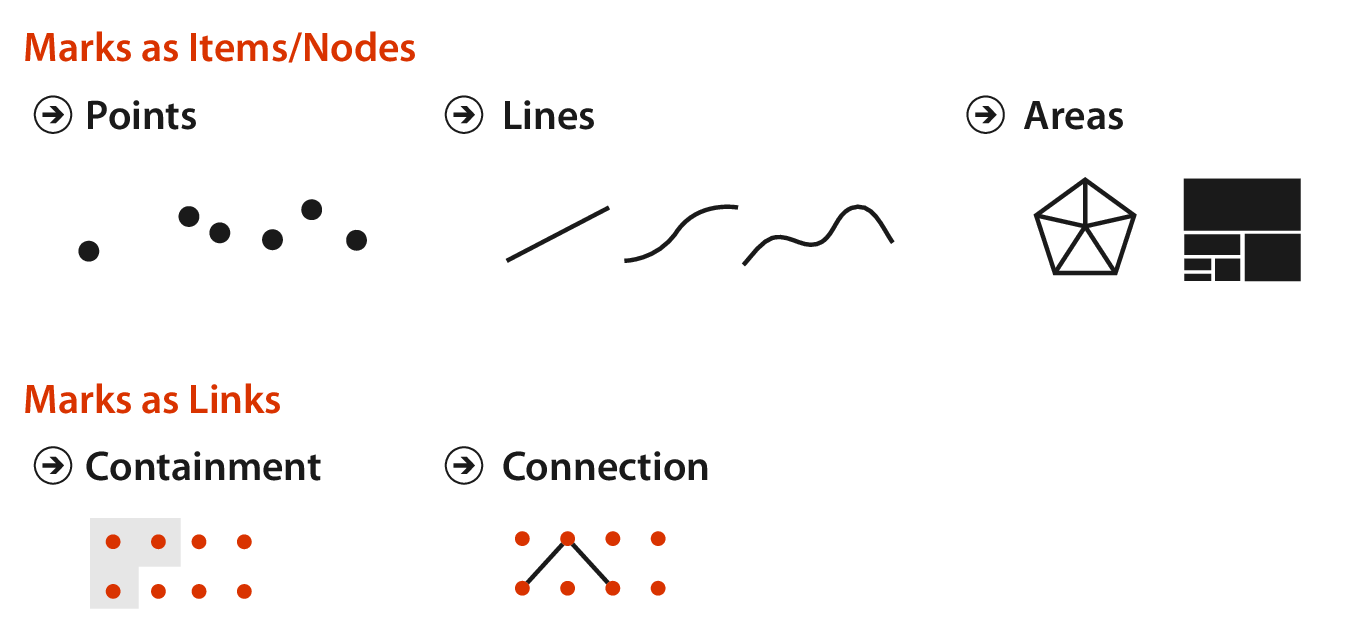
- A mark is a basic graphical element in an image.
- They are classified according to their spatial dimensions.
- 0D: Point
- 1D: Line
- 2D: Area
- 3D: Volume (uncommon)
- They are classified according to their spatial dimensions.

Channels
- A visual channel is a way to control the appearance of a mark, independent of its dimensionality.
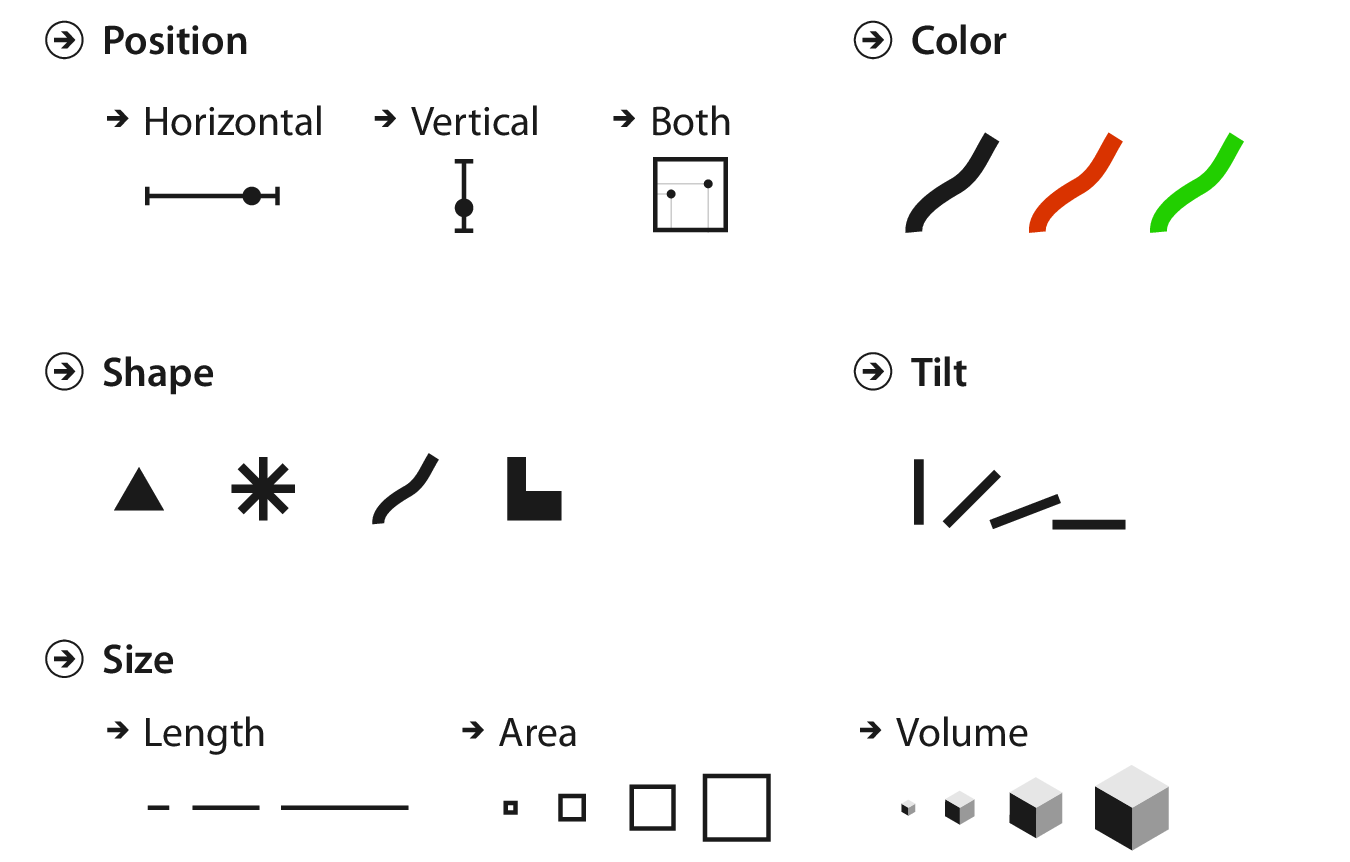
Channels
This figure shows a progression of chart types, with each panel showing one more quantitative data attribute by adding one more visual channel. Each panel uses one mark (line or point).
- Bar chart: two attributes (vertical position quantitative, horizontal position categorical)
- Scatterplot: two quantitative attributes (vertical position, horizontal position)
- Scatterplot with color: three quantitative attributes (color is categorical)
- Scatterplot with color and size: four quantitative attributes (shape is quantitative)

Channels
- In this figure, each channel shows one attribute.
- Multiple channels can be used to redundantly encode the same attribute.
- This makes that attribute very easily perceived.
- But it also “uses up” one of your channels.
Channels
- Size and shape channels cannot be used on all types of marks.
- Higher dimensional marks usually have intrinsic size/shape.
- One notable exception is the cartogram.
- Points and lines can be easily size coded.
- Higher dimensional marks usually have intrinsic size/shape.

Mark Types
- Marks reprensent different things depending on the datatype.
- For table datasets, a mark always represents an item.
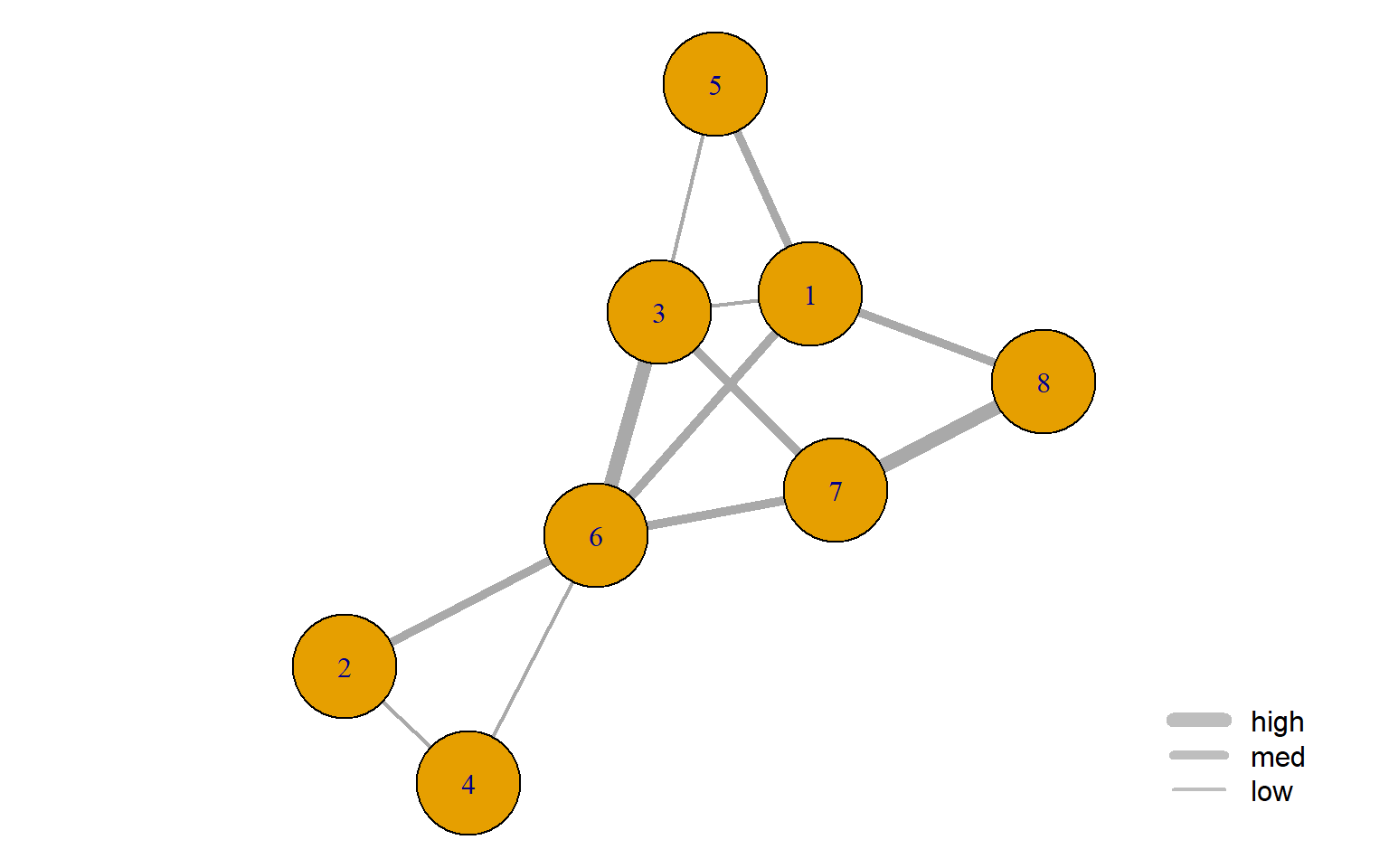
- For network datasets, a mark might represent either an item (node) or a link.
- A connection mark shows a pairwise relationship between two items.
- A containment mark shows hierarchical relationships using areas.
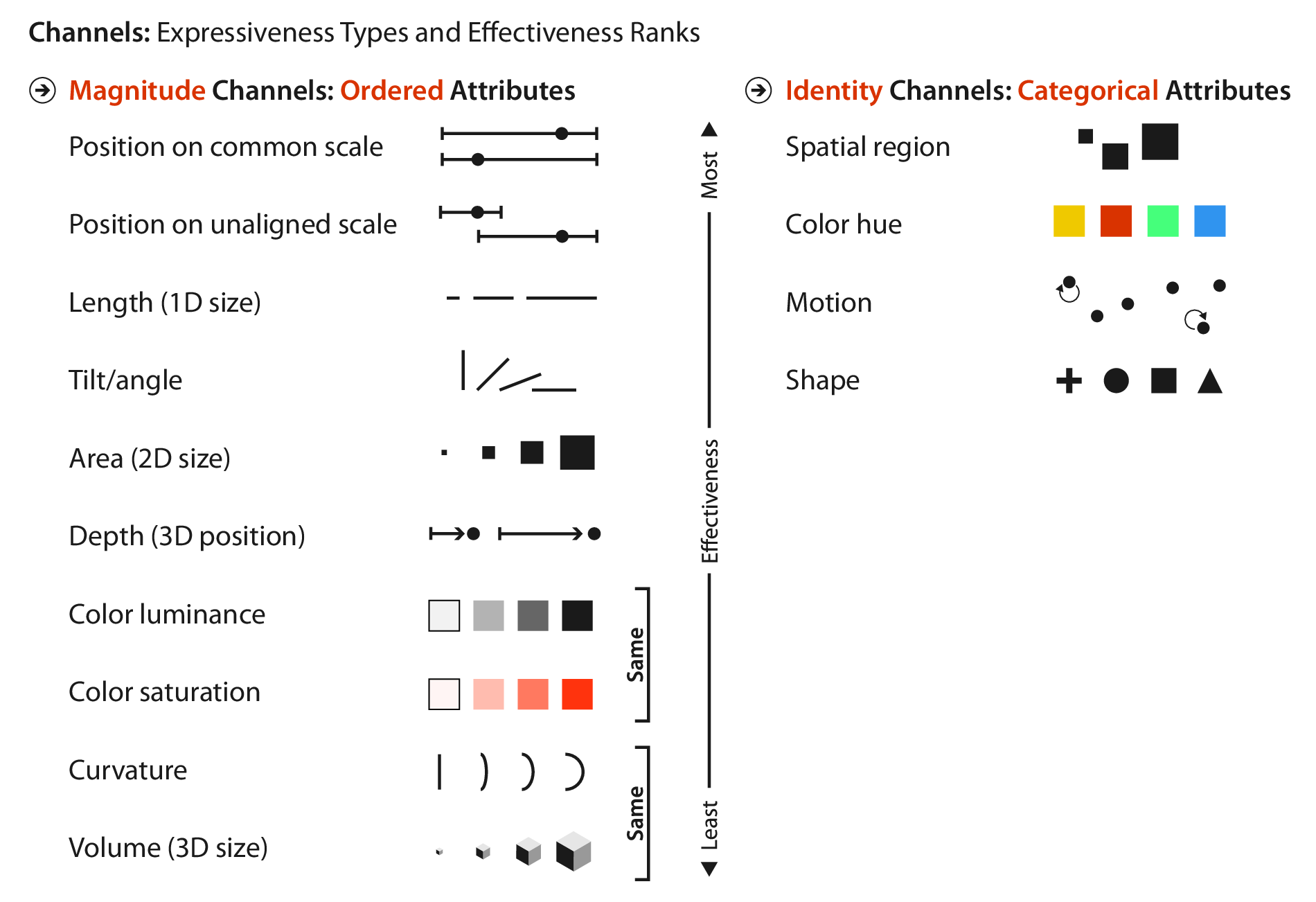
Channel Rankings
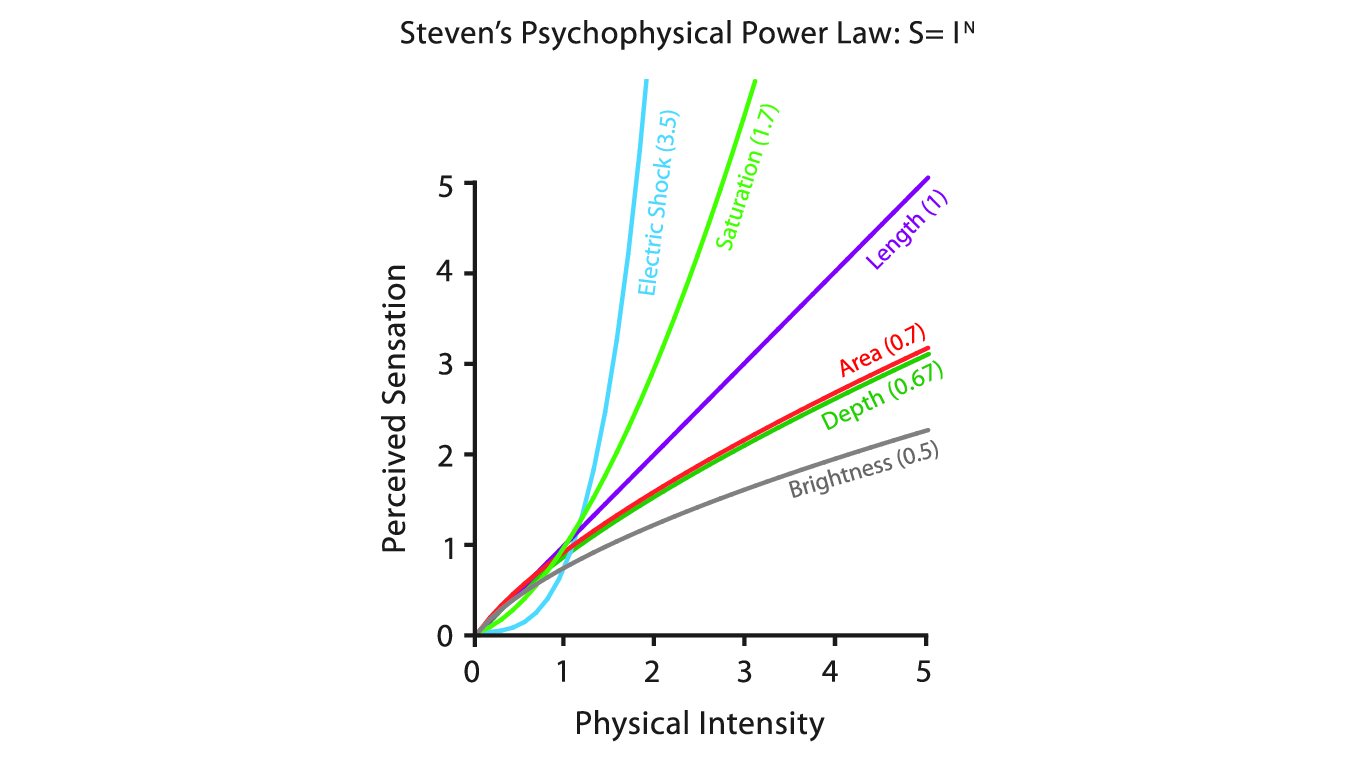
Accuracy
- The exponent for perception of length is \(n=1\).
- Perception matches objective measurement.
- The exponent for color saturation is \(n>1\).
- Perception is exaggerated above objective measurement.
- The exponent for area is \(n<1\).
- Perception is dampened below objective measurement.
Accuracy
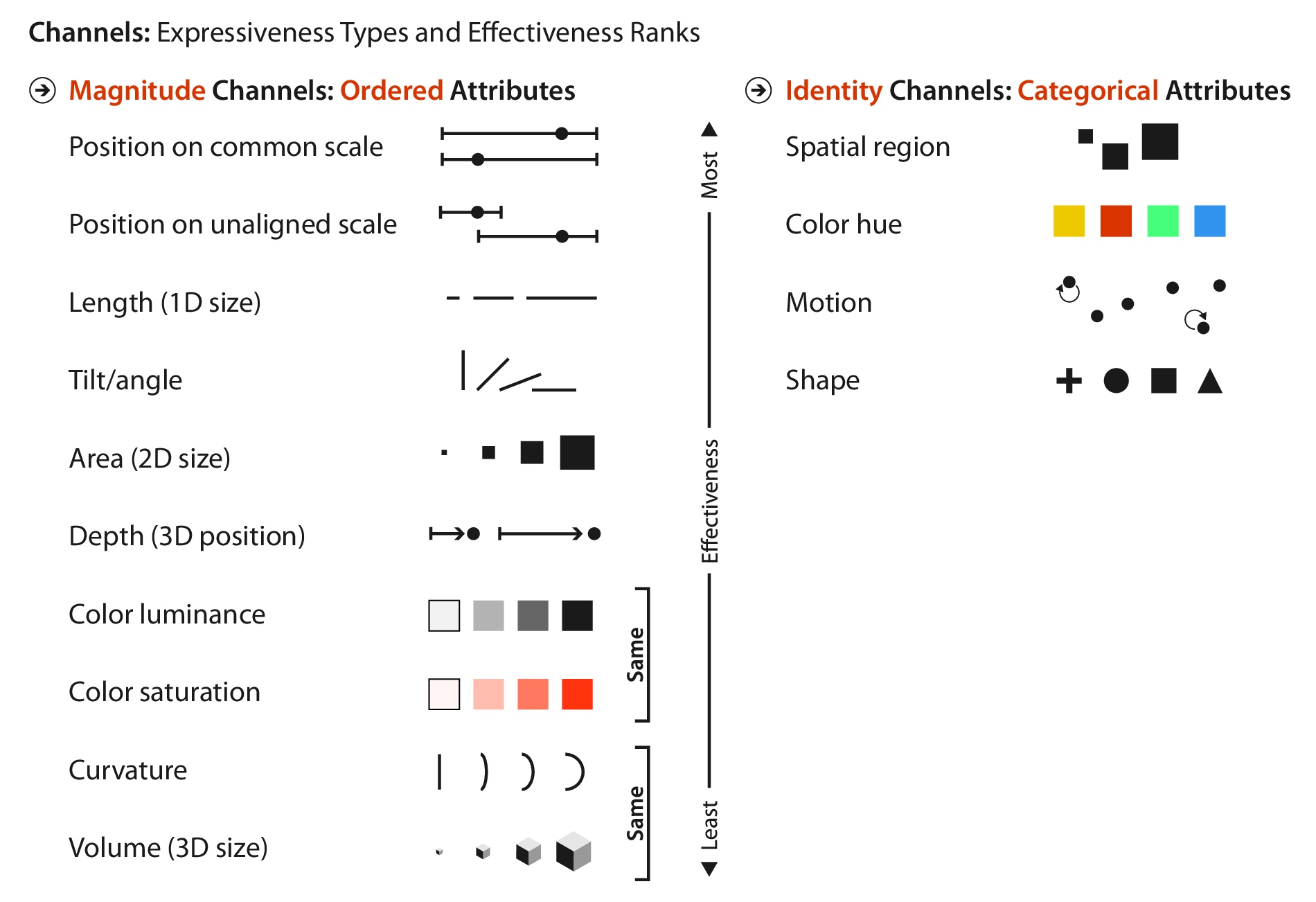
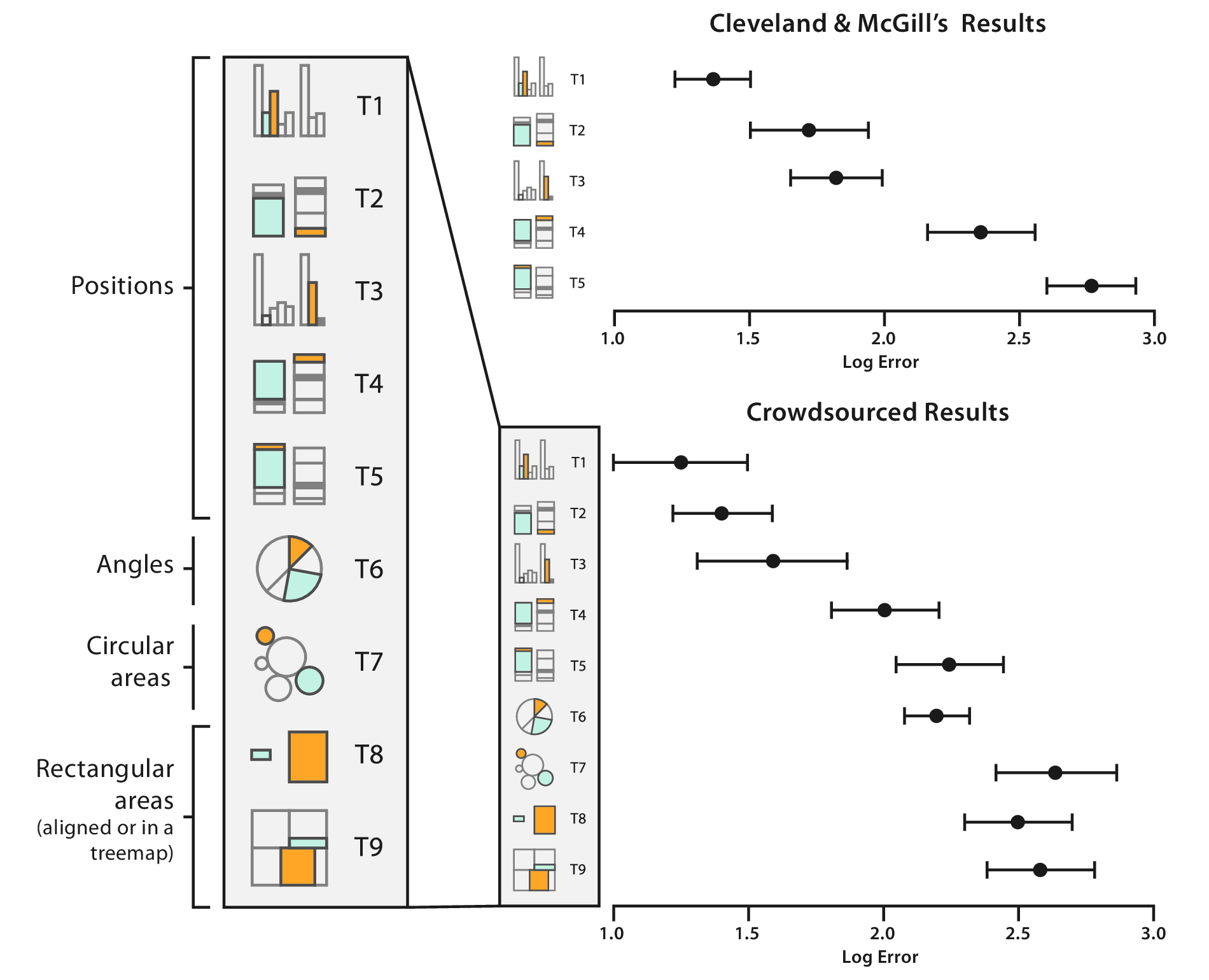
- Experimental work by Cleveland and McGill1 rannked channel accuracy:
- Aligned position against a common scale
- Unaligned position
- Line length
- Angle
- Crowdsourced results by Heer and Bostock2 supported and extended these results.
Separability
- Some channels interact with each other.
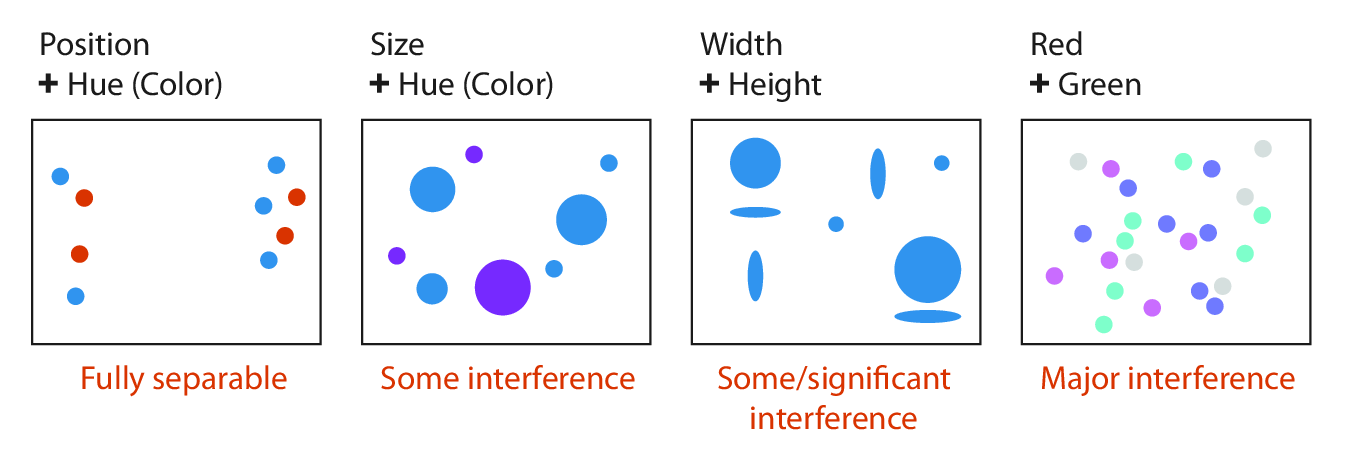
- There is a continuum from separable channels to integral channels.
- Separable channels are completely independent from each other.
- Straightfoward to use.
- Integral channels are inextricably combined.
- Visualizations can fail if these channels convey different attributes.
- Separable channels are completely independent from each other.
Separability
- Position + hue are fully separable.
- Clearly see 2 categories for both.
- Size + hue have some interference.
- More difficult to tell the color on smaller objects.
- Width + height have significant interference.
- You might see 3 groups (based on size) when there should be 4.
- Red + green have major interference.
- The two colors combine to show us 4 different hues.
Popout
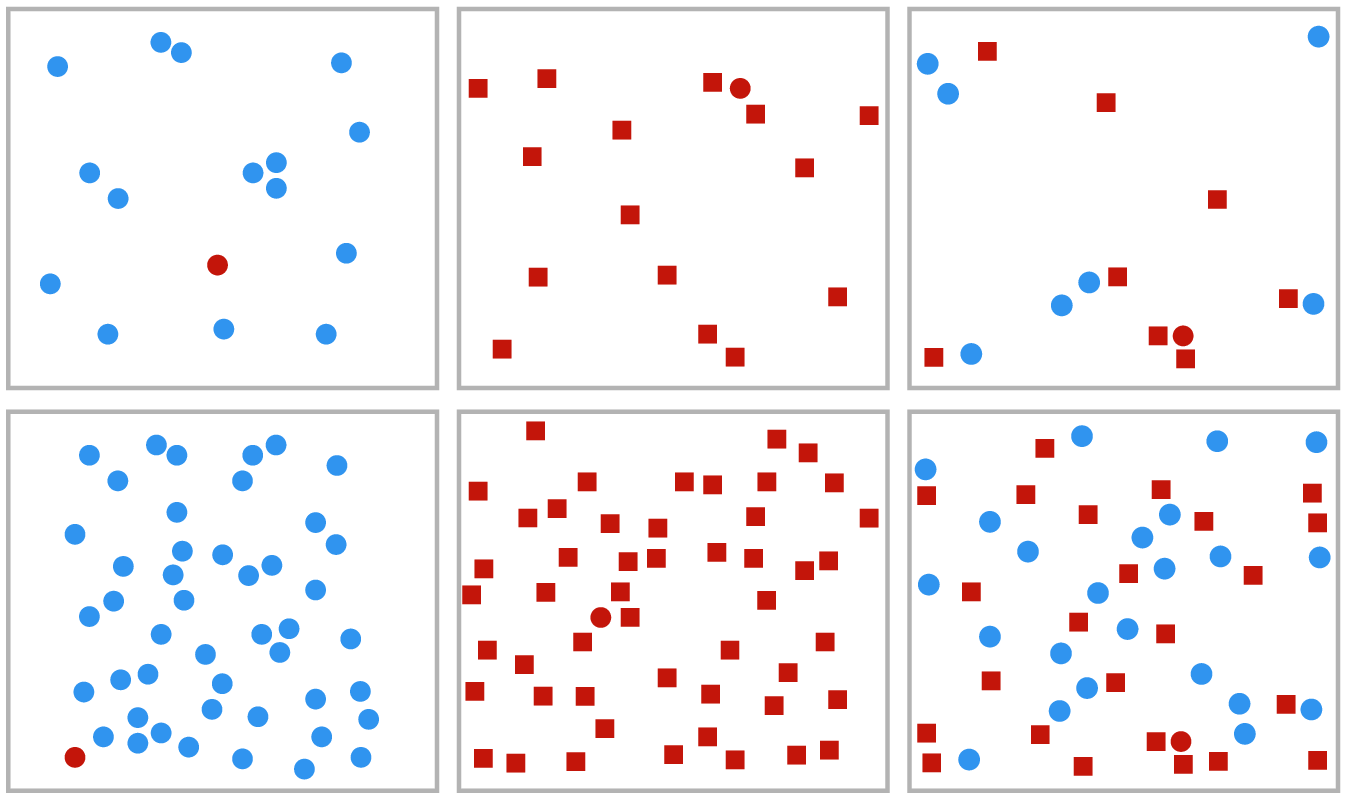
- Many channels can provide popout, where a distinct item stands out immediately.
Popout
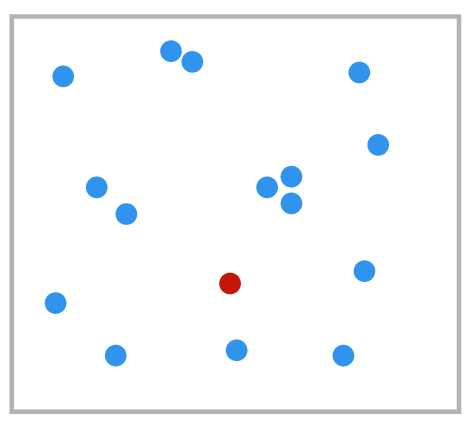
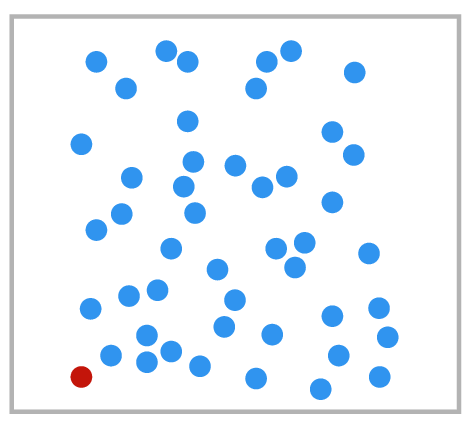
- The time it takes us to spot the red circle is roughly the same for 15 blue circles or 50 blue circles.
- Our low-level visual system does “massively parallel processing” on color channels.
Popout
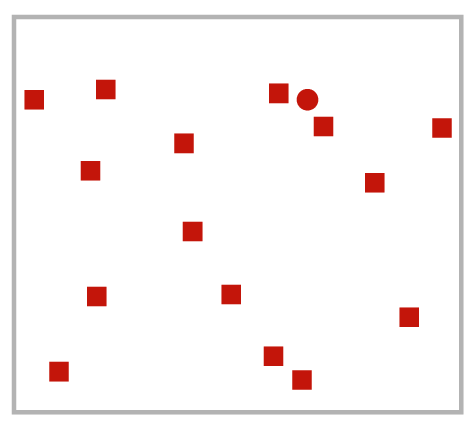
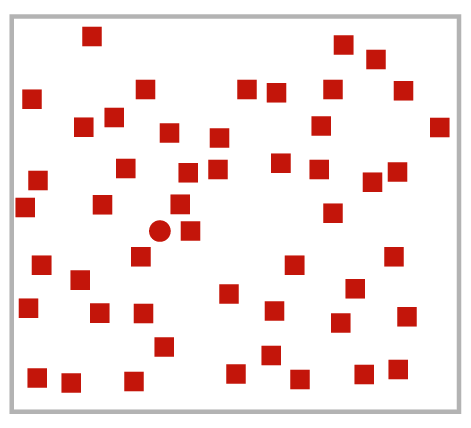
- The time it takes us to spot the red circle is roughly the same for 15 red circles or 50 red circles, but it is much slower than it was with the color difference.
Popout
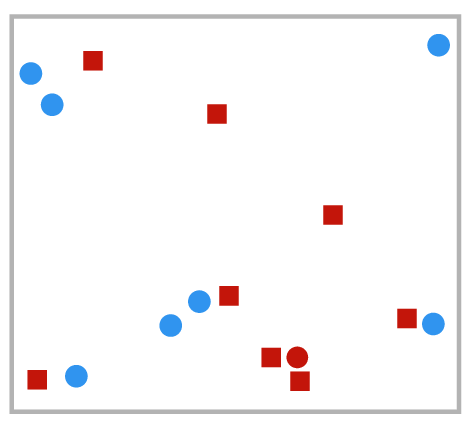
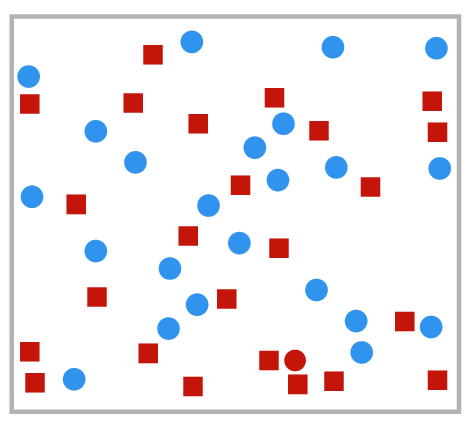
- Popout between channels can’t necessarily be combined.
- The red circle doesn’t pop out when there are both shape and color differences.
- It can only be detected by serial search, looking at each object one at a time.
- Search time increases linearly with number of distractor objects.
Popout
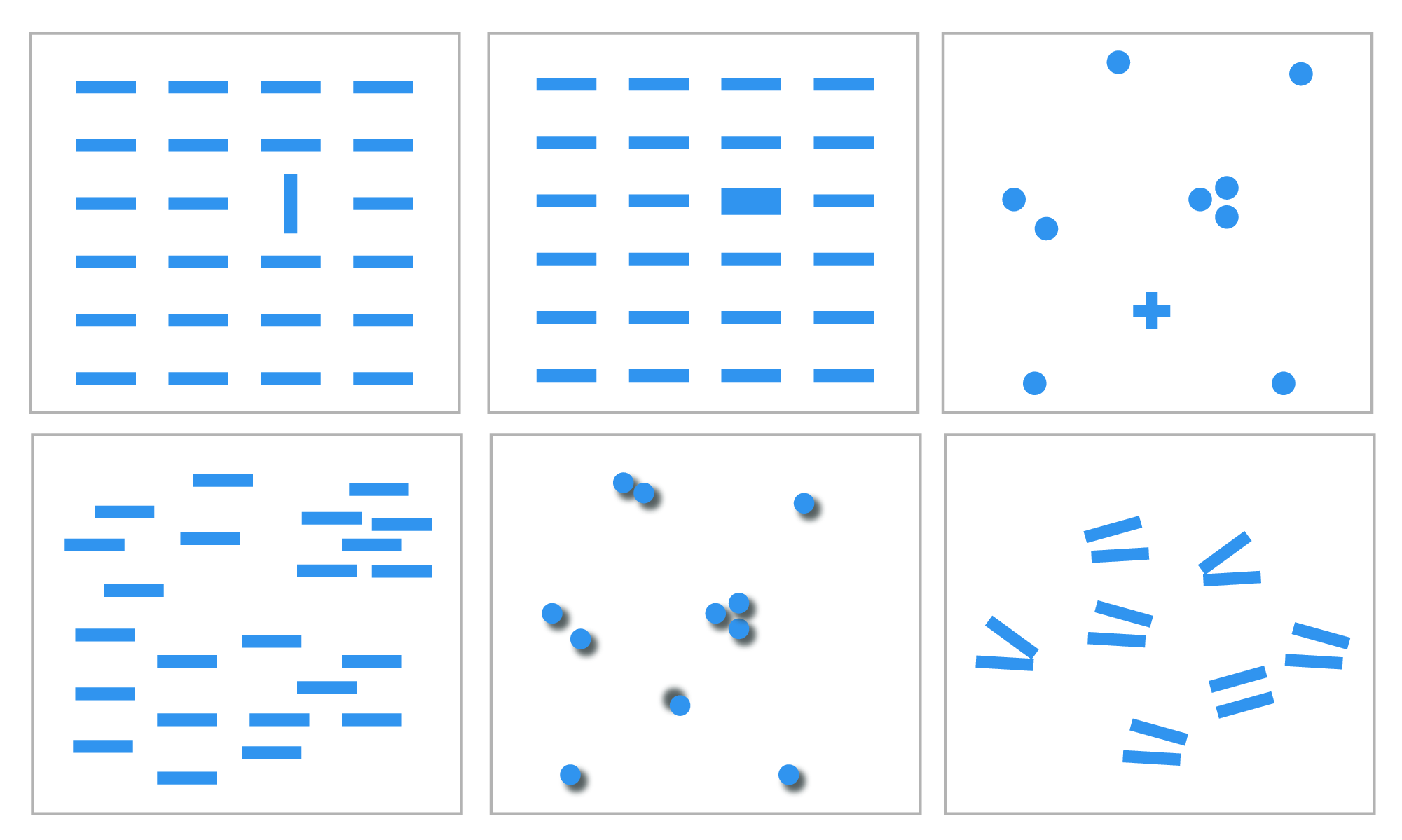
- Generally, you should only count on using popout for one channel at a time.
- Popout can occur for many channels.
- Tilt (a), size (b), shape (c), proximity (d), shadow direction (e).
- Note that parallel lines do not popout (f).
Grouping
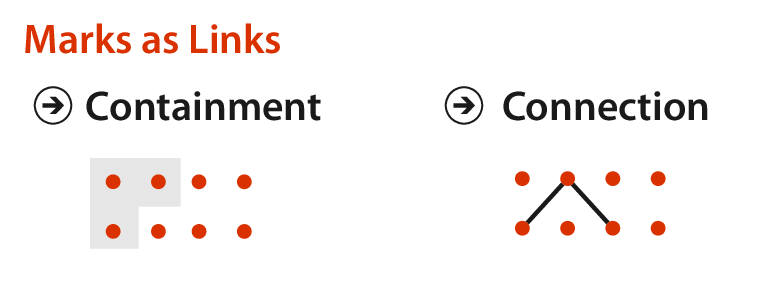
- You can convey information about grouping using link marks.
- Areas of containment are the strongest cue.
- Connection marks are the second best.
Relative vs. Absolute Judgements
- Weber’s Law tells us that the human perceptual system is based on relative judgements, not absolute judgements.
- This holds true for all sensory modalities.
Relative vs. Absolute Judgements
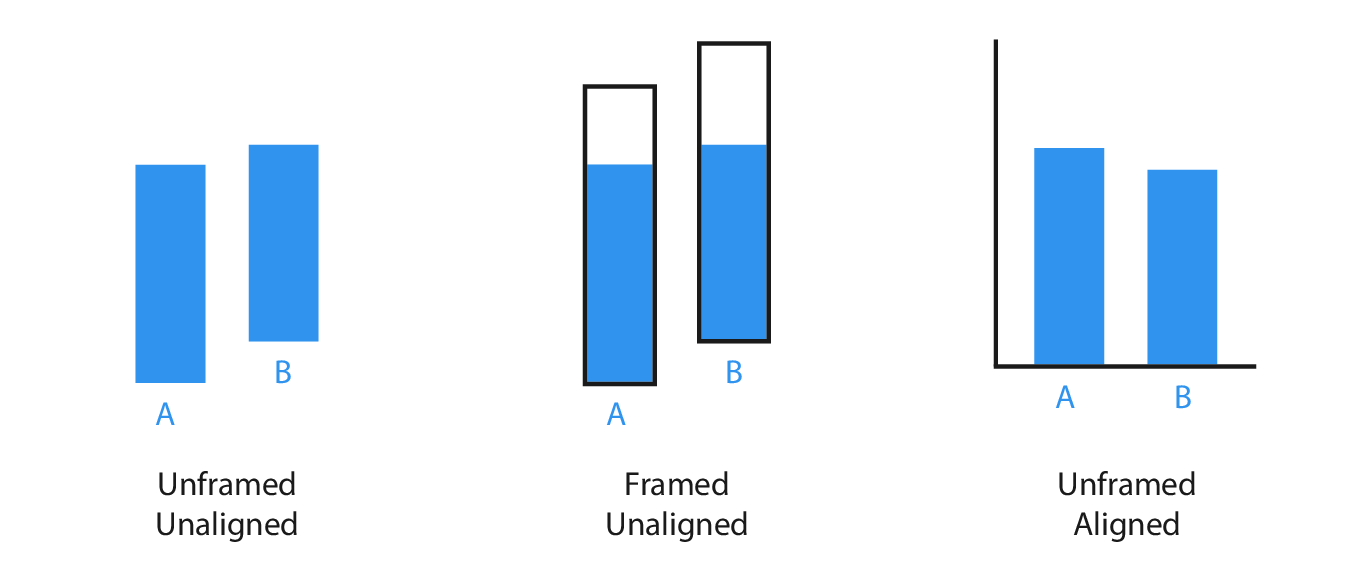
- The lengths of unframed, unaligned rectangles of slightly different sizes are hard to compare.
- Adding a frame helps.
- Aligning the bars makes judgement easy.
Relative vs. Absolute Judgements
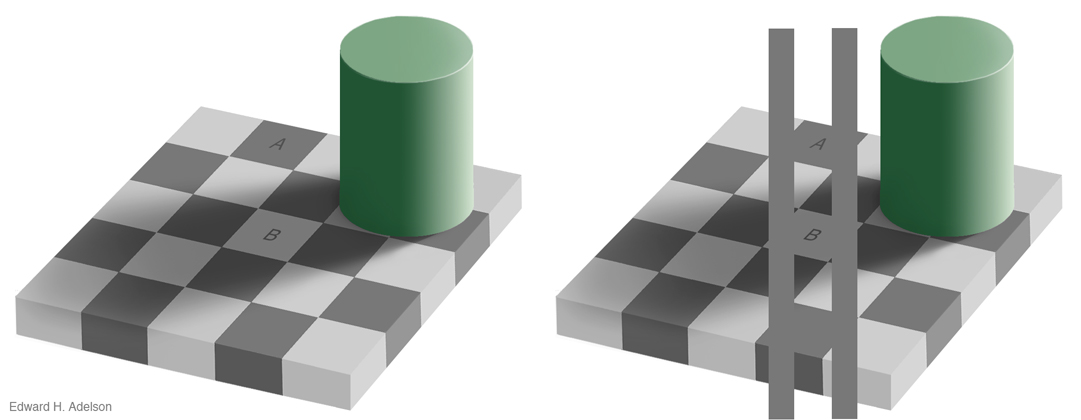
This optical illusion by Edward H. Adelson demonstrates that our perception of color and luminance is context-dependent.